What Does Climate-Controlled Storage Really Mean?
What Does Climate-Controlled Storage Really Mean?
If you’ve ever searched for a storage unit, you’ve probably seen the phrase “climate controlled” listed alongside features like security, drive-up access, and different unit sizes.
It sounds reassuring, especially when you’re storing belongings you care about. But what does climate-controlled storage actually mean? Is it just another way of saying the building has heat and air conditioning? And do you really need it for your belongings?
The answer depends on what you’re storing, how long you’re storing it, and how much protection those items need from changes in their environment.
Let’s break down what climate-controlled storage really means and when choosing it can make a difference.
What Is Climate-Controlled Storage?
At its simplest, climate-controlled storage is designed to maintain a more stable environment for your belongings than a standard storage space exposed to outside conditions.
That distinction matters.
According to the Self Storage Association, there isn’t one universally applied industry standard for the term “climate controlled.” The organization notes that true climate control generally involves managing factors such as temperature, humidity, and air movement, rather than simply heating or cooling a building.
In other words, “climate controlled” and “temperature controlled” don’t necessarily mean exactly the same thing.
That’s why it’s always worth asking a storage facility what its climate-controlled units actually provide rather than relying on the label alone.
Climate Controlled vs. Temperature Controlled: What’s the Difference?
These terms are sometimes used interchangeably, but there can be an important difference.
Temperature-controlled storage focuses primarily on keeping the space within a more moderate temperature range.
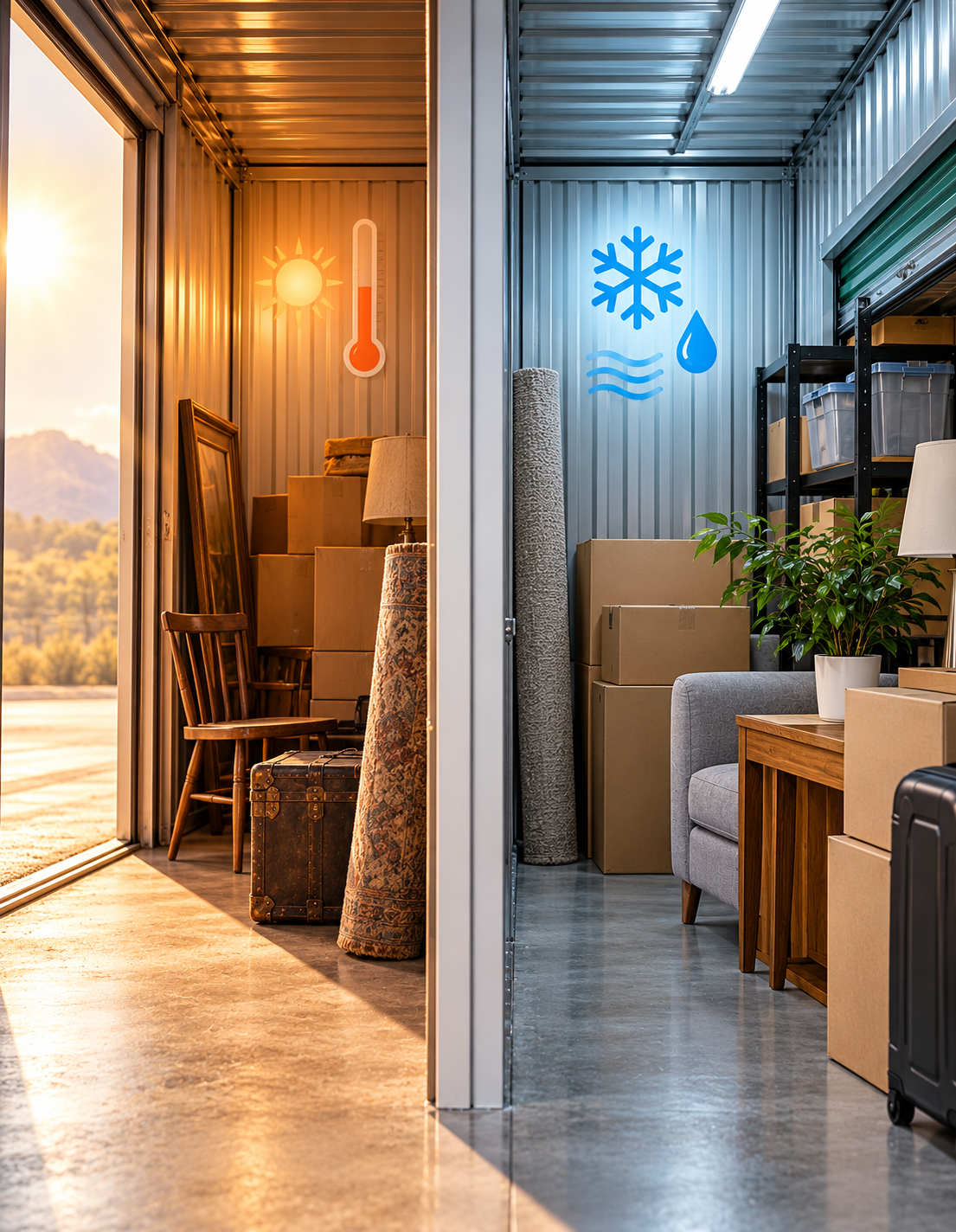
Climate-controlled storage generally goes a step further by creating a more stable indoor environment, which can include managing temperature, humidity, and airflow.
Why does that matter?
Because temperature isn’t always the biggest threat to stored belongings. Moisture and rapid environmental changes can be just as important.
Think about a wooden table, for example. Wood naturally responds to the environment around it. Repeated changes in temperature and moisture can cause it to expand, contract, warp, or crack over time.
Climate control is about creating greater stability so sensitive belongings aren’t repeatedly exposed to those swings.
What Does Climate Control Actually Protect Against?
One of the biggest misconceptions about climate-controlled storage is that it somehow makes everything inside the unit immune to damage.
It doesn’t.
Proper packing and storage still matter. What climate control does is help reduce exposure to some of the environmental conditions that can cause damage over time.
Extreme Temperature Changes
Depending on the season, temperatures inside spaces without climate control can fluctuate significantly.
A more stable environment can be particularly helpful for belongings made from materials that react to temperature changes.
Moisture and Humidity
Moisture can be especially troublesome in storage.
Excess humidity or condensation can contribute to problems such as mildew, corrosion, warped wood, damaged paper, and musty fabrics.
Climate-controlled environments can help reduce those risks by creating more consistent conditions.
Repeated Expansion and Contraction
Sometimes it isn’t one particularly hot or cold day that causes problems. It’s the repeated cycle of materials expanding and contracting as conditions change.
That’s one reason stability becomes increasingly valuable when belongings are going to be stored for several months or longer.
We talked more about how temperature changes and moisture affect stored belongings in our guide to winter storage myths and what you actually need to worry about.
What Should You Put in Climate-Controlled Storage?
Not everything needs climate control. A set of basic yard tools, for example, may have very different storage requirements than family photographs or a wooden dining table.
However, climate-controlled storage is worth considering for items that are more sensitive to changing environmental conditions.
Common examples include:
- Wood, leather, or upholstered furniture
- Electronics
- Books and important documents
- Photographs and photo albums
- Artwork
- Musical instruments
- Clothing and fabrics
- Mattresses
- Collectibles
- Business records or inventory
- Certain appliances
It can also make sense when you’re storing the contents of an apartment or home and simply don’t want to sort every item based on how sensitive it may be to temperature or moisture.
Does Climate-Controlled Storage Prevent Mold?
Climate control can help reduce the conditions that encourage mold and mildew, but it isn’t a substitute for packing your belongings correctly.
For example, putting a damp piece of furniture, rug, or piece of clothing into a storage unit and sealing it inside plastic can trap moisture right alongside the item.
Before putting anything into storage:
Make sure belongings are completely clean and dry. Avoid sealing moisture into containers. Use breathable furniture covers where appropriate, and never store food, wet materials, or anything else that can introduce unnecessary moisture into the space.
The storage environment matters, but so does what you bring into it.
Do I Really Need Climate-Controlled Storage?
Not necessarily.
If you’re storing durable belongings for a short period, standard storage may work perfectly well. But climate control becomes more valuable when your belongings are sensitive, your storage period is longer, or you simply want additional protection from environmental fluctuations.
A useful question to ask yourself is:
Would I be comfortable leaving this item in my garage through changing seasons?
If the answer is no, climate-controlled storage may be the better choice.
You should also consider how difficult or expensive an item would be to replace. Even belongings without a high dollar value, such as family photographs, documents, books, or sentimental furniture, may be worth protecting more carefully.
Climate-Controlled Storage in Colorado
Colorado weather makes this an especially relevant consideration.
Our climate can bring cold winter temperatures, hot summer days, dry conditions, and substantial temperature swings throughout the year. Your storage needs in January may look very different from your storage needs in July.
Choosing a more stable storage environment can give sensitive belongings additional protection through those seasonal changes, particularly when you’re storing long term.
Look Beyond the Label
Ultimately, the most important thing to remember is that “climate controlled” shouldn’t be the end of your research. It should be the beginning of a conversation.
Ask what the facility means by climate control. Find out where the units are located and what environmental conditions are managed. Then consider the belongings you’re storing and how much protection they actually need.
At Greenbox Self Storage, we offer climate-controlled storage options along with a variety of unit sizes to help you find the right fit for what you’re storing. Our solar-powered facilities also make it possible to get the storage space you need while choosing a company committed to more sustainable storage practices.
Whether you’re storing furniture during a move, clearing space at home, protecting business inventory, or simply trying to keep your belongings in better condition while they’re out of sight, we’re here to help you choose the storage option that makes sense.
Explore Greenbox Self Storage locations and available units to find the right space for your belongings.